
Are Corporate Meditation Programs Worth It in 2026? ROI, Data & Real Results
By mid-2026, American workplaces will look totally different. We've gotten through the Great Resignation mess and the quiet quitting phase, and now we're in what people call the "Great Exhaustion." Even with all this fancy AI and automation supposed to make things easier, everyone's hunting for burnout fixes more than ever. Home and work have blended into one big blur, people glued to screens, companies fighting to hold onto their good folks before they crash.
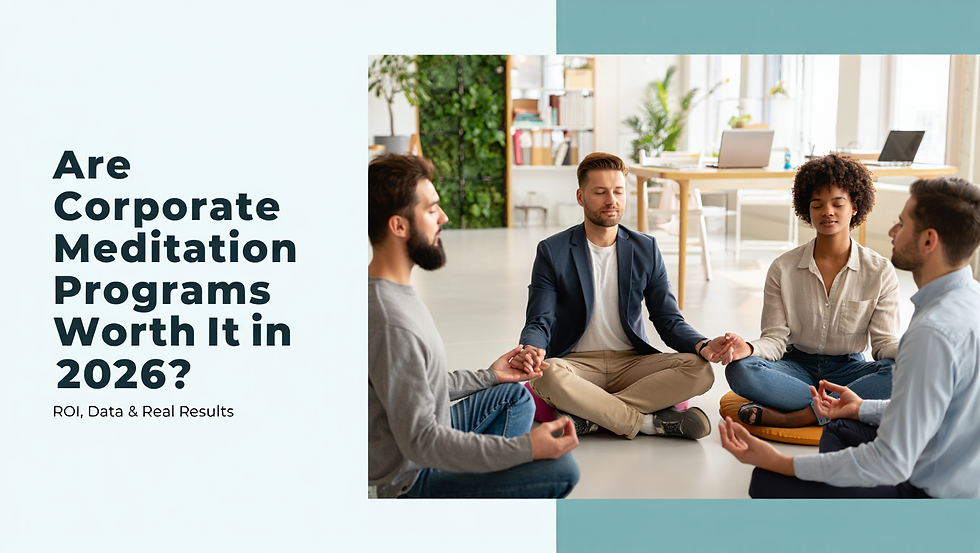
Then corporate meditation programs show up. Remember when they seemed like some flaky California thing? These days, they're a real part of how companies handle wellness in 2026. But hold on, CFOs are watching every penny in this shaky economy. The big question: Do they actually help the bottom line, or are they just a quick fix for a deeper problem?
What Are Corporate Meditation Programs?
Basically, it's organized training to help people handle their focus and feelings better. In 2026, it's way past just sitting quietly. These fit right into busy days with different styles.
Workplace mindfulness usually breaks into three types:
In-Person Sessions: Old-school workshops or quiet rooms where someone guides the group through simple techniques.
Virtual Corporate Meditation Classes: Sharp video sessions where teams from anywhere breathe and focus together, great to start meetings.
Hybrid & On-Demand Models: Live help plus apps like Headspace or Calm for Business, ready whenever you need.
Why Companies Are Investing in Meditation in 2026
This wellness push isn't about being extra kind; it's about making it. Workers deal with stresses we never saw 10 years back.
The Hybrid Paradox: Remote gives freedom but leaves you alone. Companies use meditation to build that team feeling again.
Mental Health as a Metric: Your ESG score in 2026 partly depends on how well you treat people. Stress programs tell investors you're solid and safe.
The Talent War: Young stars from Gen Z and millennials want a safe headspace more than big bucks. Mindfulness training helps you stand out when hiring.
Leaders see it now: a clear head gets stuff done.

Key Benefits of Corporate Meditation Programs
Years of brain studies prove it works across the board. When you bring these in, everyone feels it.
#1. Reclaiming the "Flow State"
Pings everywhere make focusing tough. Meditation builds up the front part of your brain for better control and less distraction. Folks get back to real work quicker after getting pulled away.
#2. Deep Dive: The Neuroscience of the 2026 Professional
In the 2026 landscape, "Deep Work" is the most valuable currency. Neuroplasticity research shows that consistent mindfulness thickens the gray matter in the Prefrontal Cortex while shrinking the Amygdala (the brain's "fight or flight" center). For an employee, this isn't just "calmness", it is the mechanical ability to ignore a Slack notification and finish a complex report in one sitting.
#3. The Direct Hit on Burnout
Burnout's more than tired, it's wiped out emotionally and physically. Meditation cuts stress hormones like cortisol. Giving time to unwind stops the slow drip of people leaving from overwork.
#4. Emotional Intelligence & Team Synergy
It helps you watch your own thoughts. In meetings, that means fewer snap reactions and more understanding. Less drama, better teamwork, and fresh ideas.
#5. Quantifiable Health Gains
Stress causes lots of missed days. Breathing and calm practices fix sleep and boost immunity, so fewer sick calls and stronger teams.
ROI of Corporate Meditation Programs: Show Me the Money
To see if they're worth it, check the numbers on wellness returns. Happiness is hard to price, but losing someone? Easy math.
The Replacement Cost Factor
Swapping a mid-level person costs 1.5 to 2 times their salary. Keep three key folks from bailing on burnout, and it pays back big.
Productivity and "Presenteeism"
It's when you're there but zoned out. 2025-2026 data says mindfulness grabs back about 60 minutes a week per person. For 500 people, that's 26,000 hours a year.
Healthcare Premium Reduction
2026 insurers give breaks for proven wellness engagement. Less stress, such as high blood pressure, means lower bills long-term.
The Hard Logic of Mindfulness ROI (Annual Estimate for 100 Employees)
Metric | Without Program | With the Meditation Program | Annual Savings |
Turnover Rate | 15% (15 people) | 12% (12 people) | $210,000 (Avg $70k Salary) |
Absenteeism | 6 days/year | 4.5 days/year | $42,000 |
Health Premiums | Standard Rate | 3% Wellness Credit | $18,000 |
Total ROI | -- | -- | $270,000+ |
The Verdict on ROI: Reports say $3 to $5 back for every $1 in good programs, one of HR's best bets.
The Evolution of "Answer Engine Optimization" (AEO) in Wellness
As we move through 2026, people aren't just searching for "meditation." They are asking AI assistants, "How do I lower work stress without quitting?" or "Best mental health benefits for remote marketing teams." To stay relevant, corporate programs have moved toward Actionable Mindfulness. It is no longer about 30-minute sit-downs; it’s about "Micro-practices", 90-second breathing resets triggered by calendar transitions or high-stress keywords in digital workspaces.
Challenges & Limitations
Not perfect. Hurdles pop up.
The "Mandatory Fun" Trap: Force it, and it flops. Stressed people hate "relax now" orders.
Participation Gaps: The busiest ones skip it most. To fix this, leaders must model the behavior. If the CEO isn't "taking a moment," the junior staff won't either.
Difficulty in Measurement: Can't count calmly like sales. Short-term proof is tricky. Companies are now using bio-metrics (like heart rate variability) to get harder data.
Quality Control: Too many bad teachers now leads to doubts. Vetting facilitators for actual clinical or corporate experience is vital in 2026.
Conclusion: Are They Worth It?
Looking at 2026 workplaces, yes, with a but. They work best in a place that respects balance. You cannot breathe away bad bosses or crazy hours.
But for building toughness, sharp focus, and real wellness payoff, nothing beats it. It gives people the internal tools they need to navigate an increasingly complex, AI-driven world. When employees feel supported, they don't just stay, they perform.
Frequently Asked Questions
1. What are corporate meditation programs?
Corporate meditation programs in 2026 are tech-enabled, or facilitator-led systems that teach employees stress regulation, focus techniques, and emotional intelligence. They range from in-office "Zen Dens" to global virtual workshops.
2. Do virtual corporate meditation classes really work?
Yes, especially for the hybrid workforce. Using high-fidelity audio and interactive "presence" tools, virtual sessions help remote workers separate "home" from "work," reducing the professional isolation common in 2026.
3. How do companies measure ROI from meditation programs?
ROI is measured through "The Big Three": Reduction in turnover costs, decrease in stress-related healthcare claims, and the reclamation of "Presenteeism" hours (time spent at the desk but not working).
4. How much does corporate meditation training cost?
Costs vary. Digital-only app subscriptions can range from $10-$50 per user per year. Custom, high-touch programs with live facilitators and biometric tracking can range from $5,000 to $50,000+, depending on company size.
5. Are meditation programs suitable for remote teams?
Remote teams need this even more. Since they don't have a commute to separate work from home, meditation creates a clear "mental boundary." It helps them start and end their day properly, stopping that 2026 "always on" burnout.
6. What is the "Great Exhaustion," and how does meditation help?
The "Great Exhaustion" is the 2026 phenomenon where workers feel mentally drained by rapid AI integration and blurred work-life boundaries. Meditation acts as a "system reboot" for the brain, lowering the cognitive load.


Comments